Why Your Tankless Water Heater Needs Regular Flushing
A tankless water heater flush is essential maintenance that removes mineral buildup from your unit’s heat exchanger, preventing damage and maintaining efficiency. Here’s what you need to know:
Key Benefits of Flushing:
- Removes calcium and magnesium deposits
- Restores optimal water flow
- Prevents heat exchanger corrosion
- Extends unit lifespan
- Improves heating efficiency
When to Flush:
- At least once per year
- Every 6 months in hard water areas
- When you notice error codes or reduced performance
Signs Your Unit Needs Flushing:
- Strange knocking or grumbling sounds
- Slower water heating
- Inconsistent water temperatures
- Error codes like E110
If you own a tankless water heater, you’ve probably heard how important regular maintenance is. But here’s what many homeowners don’t realize: mineral buildup happens faster than you think, especially if you live in an area with hard water.
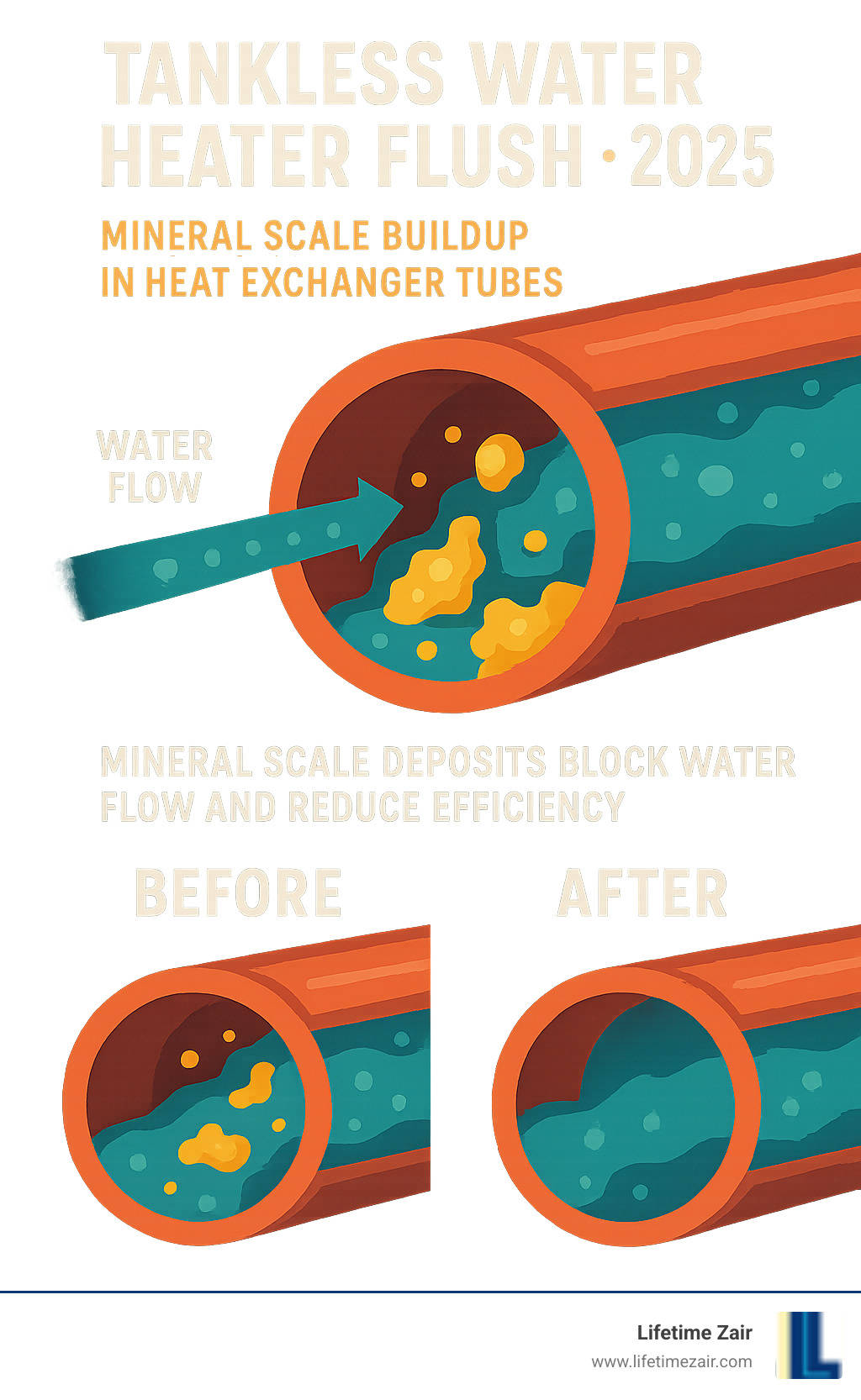
Over time, minerals like calcium and magnesium accumulate inside your tankless water heater’s small tubes. This buildup can restrict water flow, reduce heating efficiency, and even damage the unit’s walls. The good news? A simple annual flush can prevent these costly problems.
Whether you tackle this as a DIY project or hire a professional, understanding the flushing process helps us make informed decisions about our water heater’s care.
Why Flushing Your Tankless Water Heater is Non-Negotiable
Think of your tankless water heater like a hardworking friend who never complains – until suddenly, they start making weird noises and can’t keep up with their usual tasks. That’s exactly what happens when mineral buildup takes over your unit’s heat exchanger.
A tankless water heater flush isn’t just good maintenance – it’s absolutely essential for keeping your system running smoothly. Every time water flows through your unit, it leaves behind tiny mineral deposits, mainly calcium and magnesium. These minerals are harmless to us, but they’re like kryptonite to your water heater’s delicate internal components.
The Game-Changing Benefits of Regular Flushing
When you flush your tankless water heater regularly, you’re giving it a fresh start. Improved efficiency is the most immediate benefit you’ll notice. Those mineral deposits act like a thick winter coat on your heat exchanger – they make it work much harder to transfer heat to the water flowing through.
Once you remove that buildup, your unit can heat water quickly and effortlessly again. This translates directly into lower energy bills for your household. It’s like removing a clog from a drain – suddenly everything flows smoothly again.
Regular flushing also dramatically extends your unit’s lifespan. Manufacturers don’t recommend annual maintenance just to keep you busy – they know that a clean heat exchanger experiences far less stress and wear over time.
Red Flags That Scream “Flush Me Now!”
Your tankless water heater has its own way of asking for help. Water heater noises are often the first cry for attention. If you hear knocking, popping, or grumbling sounds coming from your unit, those are mineral deposits bouncing around inside like marbles in a jar.
Error codes are another clear signal – codes like E110 often indicate flow restrictions caused by mineral buildup. And if you’ve noticed inconsistent temperatures or weaker hot water pressure, your heat exchanger is likely struggling to do its job through all that scale.
The Costly Consequences of Skipping Maintenance
Ignoring these warning signs can lead to serious problems. The biggest risk is corrosion from scaling, which creates hot spots and uneven heating inside your unit. This stress can cause cracks or pinhole leaks in the heat exchanger – damage that’s expensive and sometimes impossible to repair.
In severe cases, you might need to replace the entire heat exchanger, which is like replacing the engine in your car. It’s a major component that represents a significant investment.
How Water Hardness Affects Your Flushing Schedule
The hardness of your water determines how often you need to flush. If you have soft water, annual flushing might be perfectly adequate. But if you live in an area with hard water – and many homes in our service area deal with this challenge – you’ll likely need semi-annual flushing to stay ahead of mineral buildup.
Think of it like brushing your teeth. If you eat a lot of sugary foods, you might need to brush more often to prevent problems. The same principle applies to your tankless water heater and hard water.
Your Step-by-Step Guide to a DIY Tankless Water Heater Flush
Rolling up our sleeves for a tankless water heater flush can be surprisingly satisfying! There’s something rewarding about maintaining our home systems ourselves, and honestly, it’s not as complicated as it might seem at first glance.
Before we jump in, let’s talk safety for a moment. Your manufacturer’s manual is going to be your best friend here – every unit has its quirks, and those little details matter. Keep it handy throughout the process. We’re dealing with gas lines, electrical connections, and pressurized water, so taking our time and being cautious isn’t just smart – it’s essential.
Essential Supplies for the Job
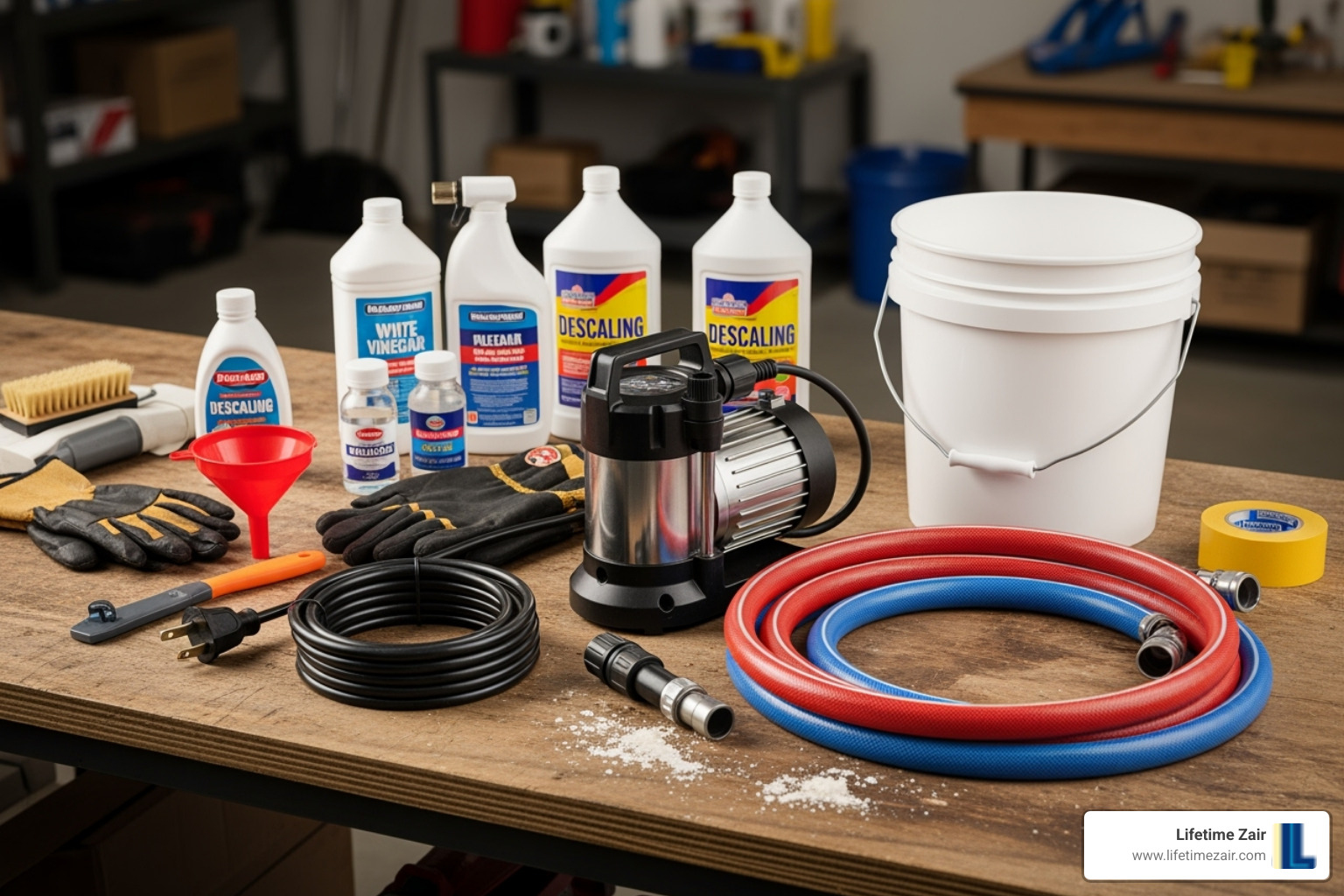
Getting the right tools makes all the difference between a smooth project and a frustrating afternoon. The good news? Most of what we need is pretty standard stuff you can pick up at any hardware store.
The heart of our operation is a submersible utility pump – aim for about 1/6 horsepower, though a 1/4 HP will work just fine too. This little workhorse is what’s going to circulate our cleaning solution through the system. Think of it as the engine of our whole operation.
We’ll also need two washing machine hoses, usually somewhere between 6 to 12 feet long. These create our cleaning loop, connecting the water heater to our pump and bucket. Make sure they’ve got the right fittings for your unit’s service ports – nothing’s more annoying than getting everything set up only to find the connections don’t match!
A clean 5-gallon bucket rounds out our setup. It doesn’t need to be fancy, but it does need to be clean – we don’t want to introduce any debris into our system while we’re trying to clean it out.
For the cleaning solution itself, we have options. White vinegar is the old reliable choice – it’s cheap, safe, and works great. You’ll need about 2 to 4 gallons of the undiluted stuff. If you prefer, commercial descaling solutions are available and sometimes work a bit faster, but vinegar gets the job done just as well.
The 7-Step Flushing Process
Now for the main event! A complete tankless water heater flush typically takes about 45 minutes to an hour of circulation time, plus setup and cleanup. Don’t rush it – your water heater has been working hard, and it deserves a thorough spa treatment.
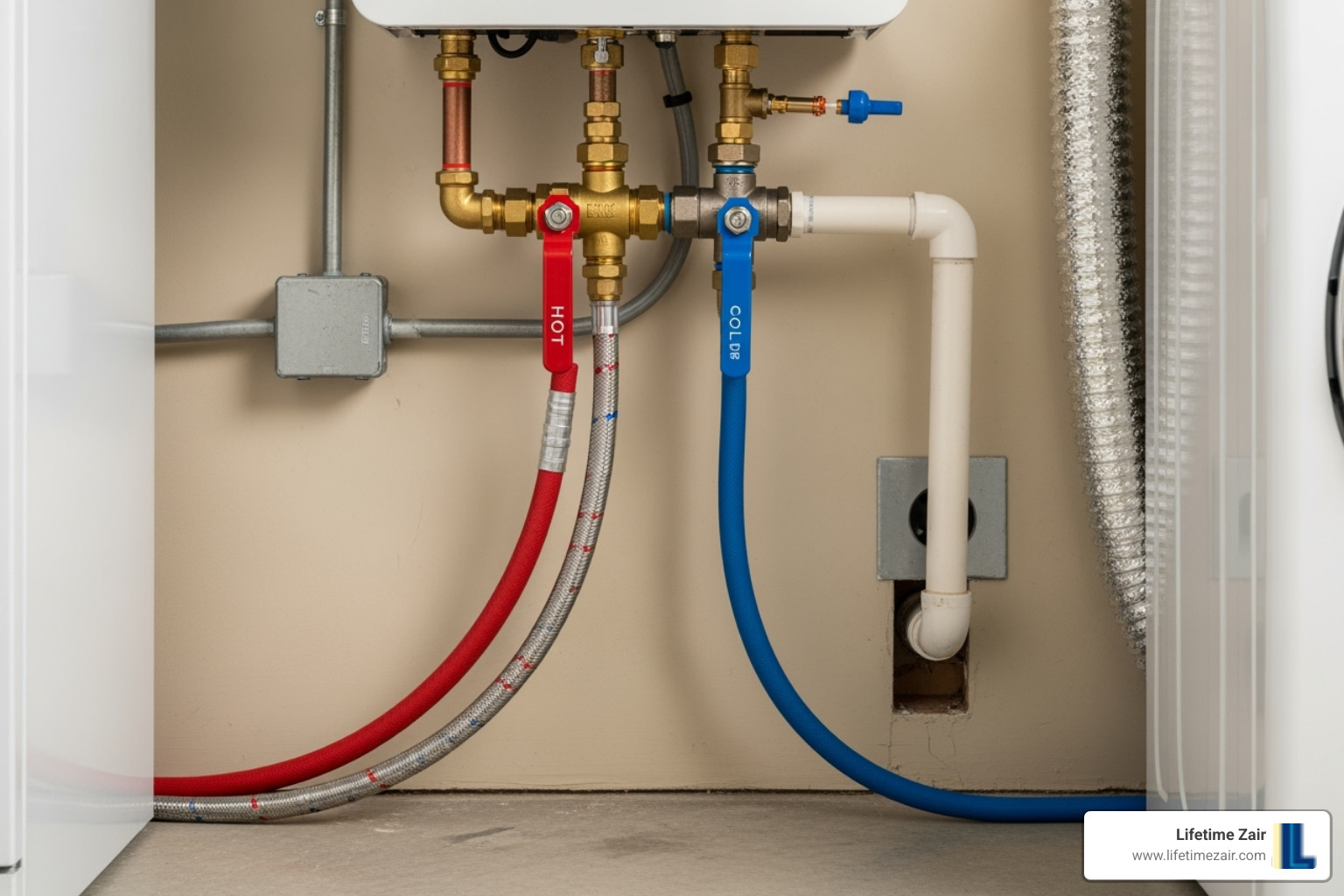
Step 1: Turn off power and gas. Safety always comes first! For gas units, find that yellow-handled gas supply valve near your unit and turn it off. If you’ve got an electric unit, head to your breaker box and flip off the circuit that powers your water heater. We definitely don’t want the unit trying to fire up while we’re working on it.
Step 2: Shut off water valves. Time to isolate our patient! Look for the hot and cold water isolation valves – they’re usually color-coded red and blue to make life easier. These valves have small T-shaped handles called purge port valves. Turn both isolation valves so they’re perpendicular to the water lines, then carefully open those purge port valve caps to release any pressure. Pro tip: don’t lose those tiny rubber sealing discs inside the caps – they’re small but mighty important!
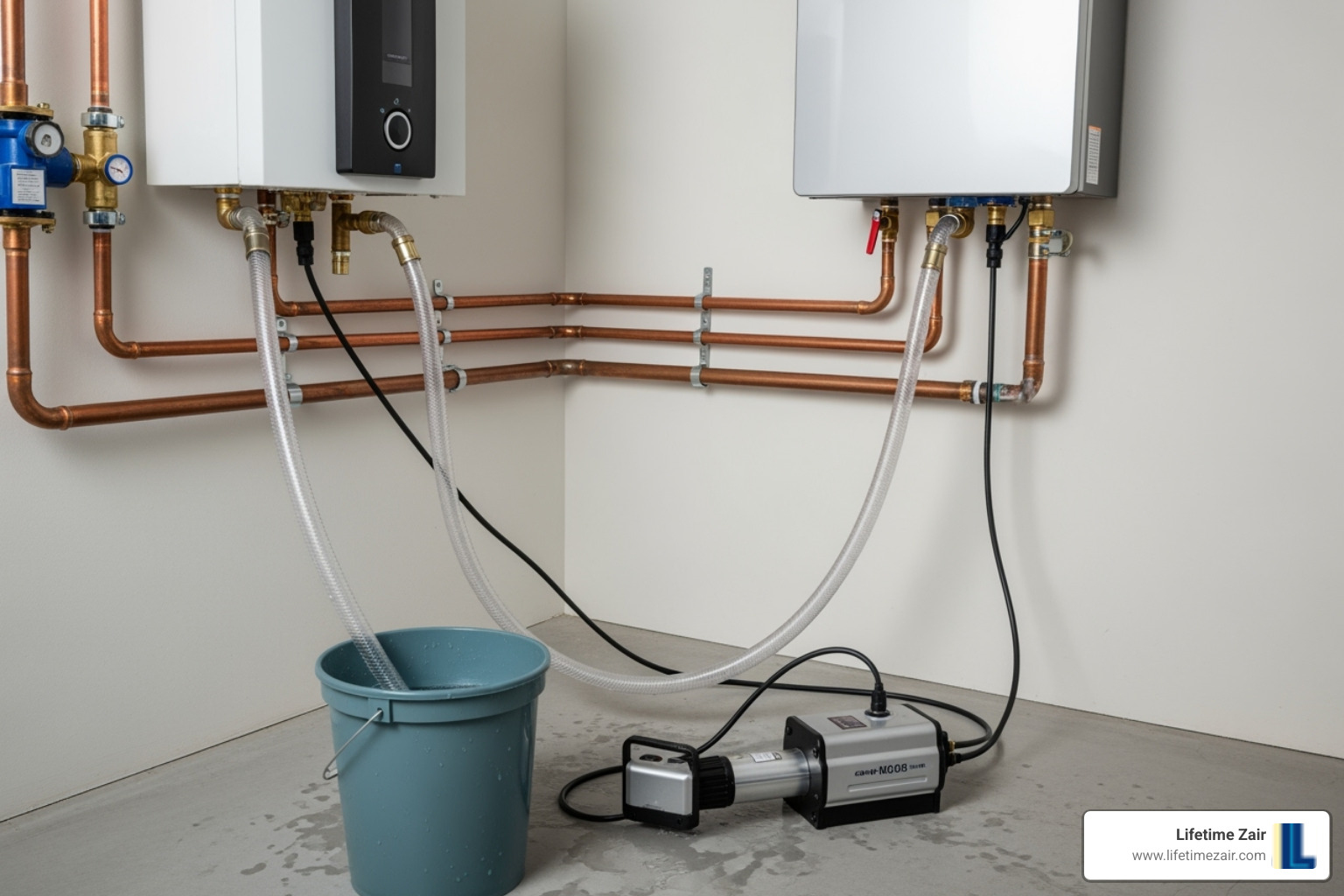
Step 3: Connect hoses. Here’s where our washing machine hoses earn their keep. Connect one hose to the cold water service port and the other to the hot water service port. Snug them up well, but don’t go crazy with the tightening – we want secure, not stripped threads. Drop the free end of the hot water hose into your bucket.
Step 4: Circulate descaling solution. This is where the magic happens! Drop your submersible pump into the bucket and connect the cold water hose to the pump’s discharge. You’ve just created a cleaning circuit – the pump pulls solution from the bucket, pushes it through the cold inlet, through all those mineral-clogged passages, out the hot outlet, and back to the bucket.
Pour your vinegar or descaling solution into the bucket, making sure both the pump and the hot water hose end are completely submerged. Fire up that pump and let it work its magic for about 45 minutes to an hour. Don’t panic if your vinegar turns a bit blue – that’s just a normal reaction with trace amounts of copper in the system.
Step 5: Flush with fresh water. After the circulation time is up, unplug the pump and disconnect the cold water hose. Close those purge port valves, then slowly open the cold water isolation valve. Fresh water from your home’s supply will now flush through the unit and out into your bucket. Let this run for 5 to 10 minutes to rinse away all that loosened mineral buildup and any remaining cleaning solution.
Step 6: Clean inlet filter. While everything’s flushing, take a moment to show some love to your inlet filter screen on the cold water line. This little guy catches debris and deserves a good cleaning too. Pull it out, rinse it under running water, or give it a vinegar soak if it’s really gunked up.
Step 7: Restore power and water. We’re in the home stretch! Close all purge port valves, remove the hoses, and replace those valve caps. Slowly open both isolation valves to restore water flow, then turn your gas and power back on. Finally, open a hot water tap somewhere in the house – a bathtub works great – and let it run for a few minutes to purge any air bubbles and make sure everything’s flowing smoothly.
Take a step back and admire your work! You’ve just completed a tankless water heater flush and given your system a new lease on life. Your future self will thank you when those energy bills stay reasonable and that hot water keeps flowing strong.
DIY vs. Professional Flushing: When to Call for Backup
Let’s be honest – there’s something deeply satisfying about rolling up our sleeves and tackling home maintenance ourselves. A DIY tankless water heater flush can save us money and give us that wonderful “I did it myself!” feeling. But before we dive headfirst into this project, we need to take a step back and honestly assess our comfort level with plumbing tasks.
The truth is, while the flushing process itself is pretty straightforward, things can go sideways if we’re not careful. Improper execution might lead to leaks, damage to our unit, or – and this is the nightmare scenario – water damage throughout our home. Nobody wants to explain to their insurance company how a simple maintenance task turned into a flooded basement!
Here’s another reality check: time commitment matters. While a seasoned professional can breeze through a flush in under an hour, those of us doing it ourselves should plan for several hours. We need time to gather supplies, set everything up, perform the actual flush, and clean up afterward. It’s not a quick Saturday morning project.
The most important thing to remember is that timely maintenance is non-negotiable, regardless of who performs the flush. Whether we tackle it ourselves or call in the pros, neglecting this essential maintenance will eventually lead to reduced efficiency and some seriously costly repairs down the road.
When to Hire a Professional for a Tankless Water Heater Flush
Sometimes, the smart money is on calling in the experts. There are specific situations where attempting a DIY flush isn’t just inconvenient – it’s genuinely not recommended.
If our tankless water heater doesn’t have proper isolation valves installed (those hot and cold water shut-off valves with built-in purge ports), we’re stuck. Without these, we simply can’t perform the flush correctly or safely. Installing these valves requires professional plumbing expertise and isn’t a DIY-friendly project.
Let’s talk comfort levels for a moment. If the thought of connecting hoses, manipulating valves, or dealing with pressurized water makes us break out in a cold sweat, there’s absolutely no shame in calling a professional. We all have different skill sets, and knowing our limits is actually pretty wise!
Complex error codes are another red flag. While some error codes simply indicate it’s time for a flush, others can signal more serious underlying problems. If our unit is displaying persistent or unfamiliar error codes, a professional can diagnose what’s really going on instead of us playing guessing games.
Here’s something that might surprise us: flushing can sometimes reveal hidden problems. If we notice any new leaks after completing a flush – even tiny drips – it’s time to call a plumber immediately. The flushing process can expose pre-existing issues that were previously masked by mineral buildup.
Beyond basic flushing needs, if we’re dealing with signs that point to larger repair issues – like no hot water, severely low pressure, strange smells, or a completely unresponsive unit – these are clear indicators that we need more than just a flush. A professional can provide comprehensive diagnosis and repair services.
Questions to Ask Your Plumber
When we decide to hire a professional for our tankless water heater flush, asking the right questions helps ensure we’re getting expert care for our valuable appliance. Think of it as interviewing someone for an important job – because that’s exactly what we’re doing!
Experience with our specific brand matters more than we might think. While the general flushing process is similar across brands, some manufacturers have unique recommendations or quirks. We want to ask: “Are you familiar with flushing my specific brand and model?”
The type of descaling solution they use is worth discussing too. Most professionals use commercial-grade solutions that work faster than household vinegar, but we should confirm it’s compatible with our water heater brand. A simple “What descaling solution will you be using?” covers this base.
Process duration gives us realistic expectations. A professional should be able to complete the job in under an hour, so if someone quotes significantly longer, it’s worth asking why.
We definitely want to know about their post-flush system check. A thorough professional will verify that all cleaning solution is completely flushed out and check for proper operation and any potential leaks. This step is crucial for our peace of mind.
Warranty considerations are important on two fronts. First, will their service affect our unit’s existing warranty? Second, do they offer any warranty on their work? These are fair questions that any reputable service provider should answer confidently.
Finally, we should ask for guidance specific to our situation. A knowledgeable technician might recommend additional steps based on our water quality – like suggesting a water softener if we’re in a particularly hard water area. This kind of personalized advice is one of the real benefits of working with experienced professionals.
Frequently Asked Questions About the Tankless Water Heater Flush
We get plenty of questions from homeowners about the ins and outs of maintaining their tankless units. Let’s explore the most common concerns about the tankless water heater flush process and clear up any confusion you might have.
What is the role of a descaling solution in the flushing process?
Think of descaling solution as the heavy lifter in your tankless water heater flush. Its main job is mineral dissolution – breaking down those stubborn deposits that have been building up inside your heat exchanger over time.
The real troublemakers here are calcium and magnesium minerals that naturally exist in our water supply. These minerals love to stick to metal surfaces, creating a crusty buildup that’s like barnacles on a ship’s hull. When we circulate a mild acid solution like white vinegar through the system, it chemically reacts with these alkaline deposits and dissolves them into a form that can be easily washed away.
This process is crucial for restoring water flow through those narrow tubes in your heat exchanger. Without proper descaling, simply running water through the system would be like trying to clean your shower with just water – it might remove some loose dirt, but the soap scum stays put. The descaling solution is what actually breaks down the mineral “soap scum” in your water heater, protecting the heat exchanger from damage and keeping everything running smoothly.
Can flushing a tankless water heater reveal existing leaks?
Here’s something that catches many homeowners off guard – yes, a tankless water heater flush can sometimes reveal leaks that were already there. Before you panic, let us explain why this is actually good news!
Over time, scale buildup can act like nature’s own Band-Aid, temporarily sealing tiny pinhole leaks or small imperfections in your heat exchanger. These microscopic leaks might have been developing for months or even years, but the mineral deposits were essentially plugging the holes, keeping them hidden from view.
When the descaling solution does its job and dissolves away all that buildup, it can expose these pre-existing weak spots. Think of it like removing old wallpaper and finding cracks in the wall underneath – the cracks were always there, but now you can see them.
This revelation is actually a blessing in disguise. Finding these issues during a routine post-flush inspection means you can address them before they turn into major problems. What to do if you find a leak? Turn off the water supply to your unit immediately and call a qualified plumber. It’s much better to catch these issues early than to wake up to a flooded utility room!
Are there effective alternatives to vinegar for flushing?
While white vinegar is the go-to choice for many DIY enthusiasts, there are definitely other options for your tankless water heater flush. Commercial descaling solutions are specifically formulated for this task and often contain citric acid, which is a powerful yet safe organic compound.
The biggest advantage of commercial products is their faster action. Many can complete the job in about 30 minutes, compared to the hour or more that vinegar typically requires. They’re designed to be more aggressive against stubborn mineral buildup while still being safe for your system.
However, before you grab any descaling product off the shelf, always check your manufacturer recommendations. Some brands specifically endorse certain products, and following their guidance helps protect your warranty. When it comes to safety, never use harsh household cleaners or chemicals not designed for water heaters – they can damage internal components or create health hazards.
The bottom line? Whether you choose vinegar for its affordability and availability, or opt for a commercial solution for its speed, both can effectively maintain your tankless water heater when used properly. The most important thing is that you’re doing the flush regularly!
Conclusion: Keep the Hot Water Flowing
As we wrap up our journey through tankless water heater flush maintenance, it’s clear that this simple annual task is truly a game-changer for our home comfort systems. Think of it as giving your water heater a spa day – it comes out refreshed, refreshd, and ready to serve you better than ever!
The benefits we’ve discussed throughout this guide are substantial and long-lasting. Regular flushing improves efficiency by removing those stubborn mineral deposits that force your unit to work overtime. It extends your water heater’s lifespan, protecting your investment and delaying the need for replacement. Perhaps most importantly for our monthly budgets, it leads to lower energy bills by restoring your unit’s ability to heat water quickly and effectively.
Routine maintenance isn’t just about fixing problems – it’s about preventing them entirely. When we stay ahead of mineral buildup with consistent flushing, we avoid those frustrating moments when the shower suddenly runs cold or when strange noises start echoing through our walls at odd hours.
Proactive care means never having to worry whether your morning shower will have hot water or if your dishwasher will clean properly. It’s about peace of mind and reliability in our daily routines. Whether you’re comfortable tackling the DIY approach we’ve outlined or prefer to have professionals handle the task, the key is making it happen consistently.
At Lifetime Zair, we’ve seen how proper maintenance transforms the reliability of home comfort systems. We believe in empowering homeowners with knowledge while standing ready to provide expert support when needed. Our team understands that every home is unique, and we’re here to help you find the maintenance approach that works best for your situation and schedule.
Don’t let mineral buildup steal your hot water comfort. Accept the power of regular maintenance, and enjoy the confidence that comes with a well-cared-for tankless water heater. Your future self will thank you every time you turn on that faucet and feel the perfect temperature flowing freely.
Get professional help with your water heater in Carrollton, TX.